
It is believed that the word asphalt is derived from the prehistoric Akkadian term “asphaltic”. This term was adopted by the Homeric Greeks to mean to tighten or stabilize. Asphalt is a construction material that has been known and proven for more than 5000 years. The first asphalt applications in Turkey started in the Ottoman period and support was received from the French in the construction of the pavements. During the Republic period, asphalt pavement construction, which started in 1929, was expanded in 1948 with the Marshall Technical assistance provided by the USA, and a period of continuous development began with the establishment of the General Directorate of Highways – KGM in 1950.
The general purpose of
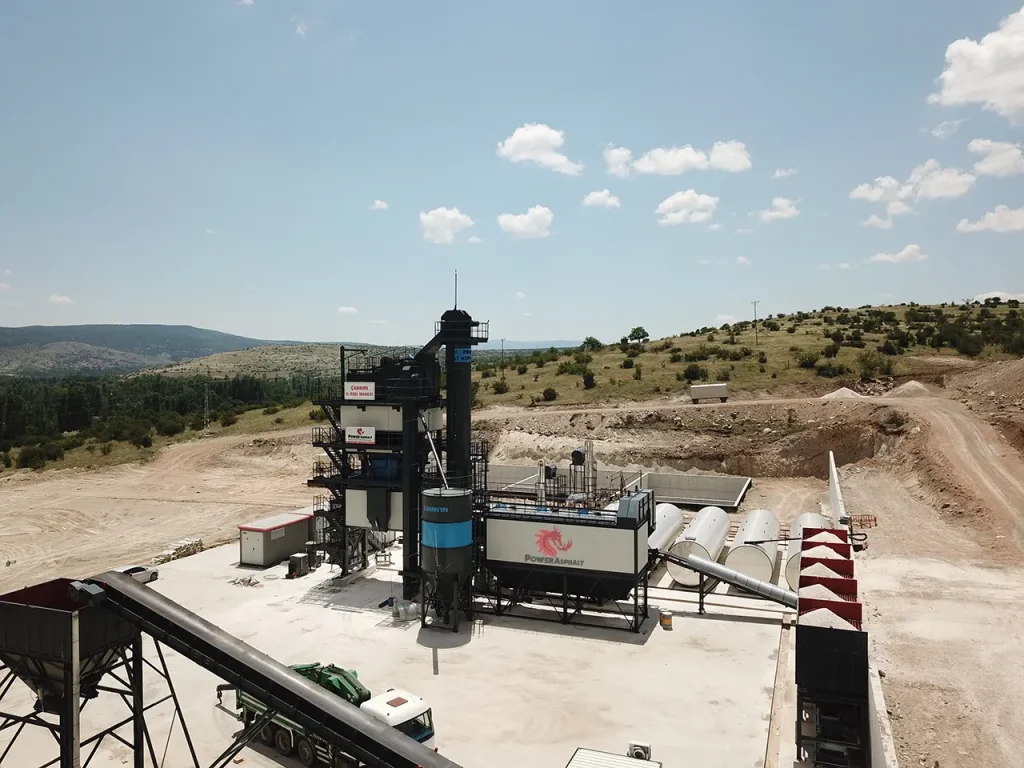
Asphalt plants is; It is the careful, high-quality, high-performance, high-capacity production of hot bituminous mixtures used on high-standard roads. The first asphalt mixture plant was put into operation between 1920 and 1930. Basically, asphalt plants are divided into two: batch type and continuous type.
Batch type asphalt plants is that after the aggregate fed by the under-bunker collection band is dried, unlike the continuous (continuous) type, it is directed to the sieves with a hot aggregate elevator and the aggregate separated according to its size is mixed with bituminous binder in the mixer.
Batch type asphalt type, drying, sifting, proportioning and mixing first came together in a plant in 1870. Even though these plants do not meet today’s standards, they formed the basis of the plant.20. At the beginning of the century, the facility continued to develop by adding bunkers and cold elevators. In the early 1930s, the facilities started to produce between 800 and 1000 tons. The feeding system was obtained by adding the conveyor system in the 1940s. In the 1950s, dryer sizes were enlarged and automatic weighing systems were introduced, making it the most advanced version up to that time. In the 1970s, the automatic control system continued to develop with technology by connecting it to the computer. In the 1980s and 90s, filtering and calibration systems were added to minimize the margin of error.
Continuous type asphalt plantsis that the aggregate fed proportionally by the under-bunker collection band is mixed with bituminous binder in the dryer/mixer and the production continues uninterrupted.
Continuous type asphalt plantsdates back to the 1910s when drum mixers started producing hot mixtures. More than 100 drum mixers were produced and used in the world until the mid-1930s. Drum mixers were developed in the 1960s. In the 1970s, drum mixers became very popular due to their portability. The mixing and heating process was developed with new configurations in the 1990s. Additionally, methods of incorporating recycled materials into the mixture have been added. Finally, it took its current form by providing faster feeding of the aggregate with a computer-controlled weighing system.