 Bitumen , comes from Sanskrit. While some claim that its Latin equivalent is gwitu-men (related to pitch), others claim that it originates from the term pixtu-men (bubbling pitch) and that this term was later shortened to bitumen and passed into English from French.
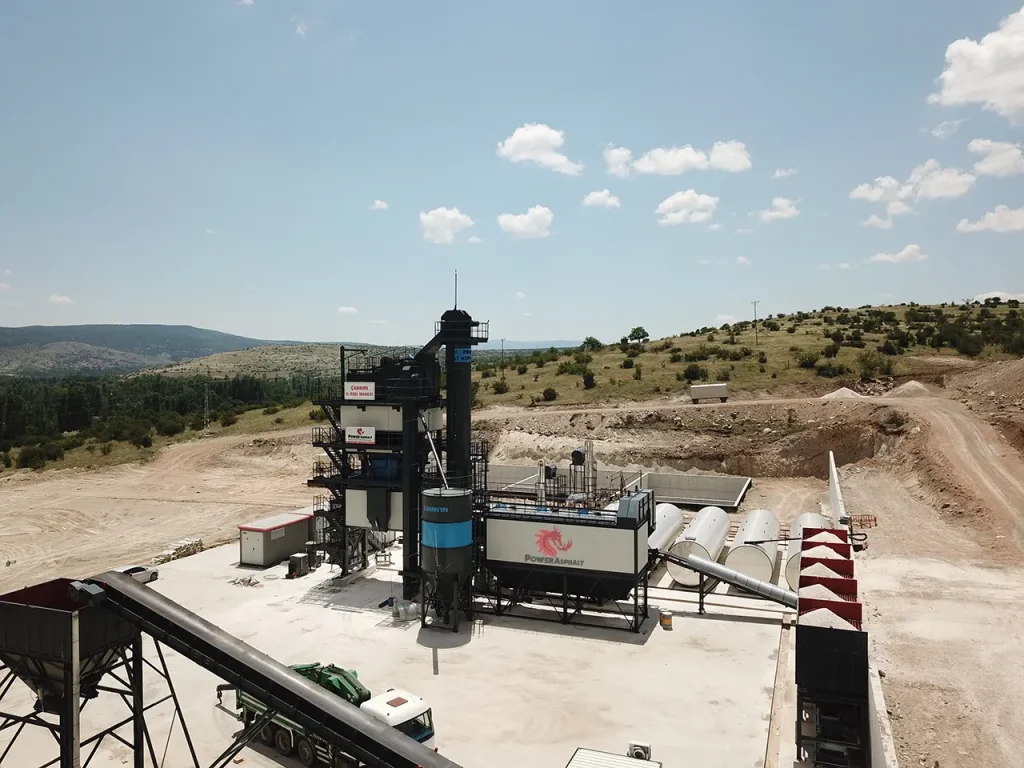
Bitumen is a hydrocarbon compound obtained by natural precipitation of crude oil or distillation in refineries, and can exist in solid, semi-solid or liquid states, with a color ranging from dark brown to black. In short, bitumen is obtained from crude oil. Bitumen can be found as a natural deposit, obtained during the refining process of petroleum, or as a compound of naturally occurring asphalt along with mineral substances. bitumen Asphalt Mixing Plants.
Due to its foundation resistance, waterproofing and natural adhesive properties, it is used in many areas such as road construction, roofing, foundation insulation, flooring, mastication and painting.
Before bitumen can be used, it must be separated, purified, mixed and sometimes chemically or physically modified. When bitumen is handled properly, it can be reheated or stored at high temperatures for a long time without losing its properties. However, improper handling of bitumen by excessive heating or using conditions that can cause oxidation can affect its properties and the long-term performance of materials made from it. That’s why bitumen should always be stored and handled at the most optimum temperature possible. In normal operations, that is, for the mixing and transfer of liquid bitumen, it is recommended to do it at a temperature between 10°C and 50°C above the minimum pumping temperature. However, the temperature of 230°C should not be exceeded to prevent the bitumen from self-igniting.
Bitumen is produced in 4 types as penetration type, oxidized, hard and cutback bitumen, and they are distinguished from each other by combinations of penetration, viscosity and softening point. The majority of penetration grade bitumen is used in road construction. Oxidized bitumens are used in roofing, flooring, mastication and pipe coating works. Hard bitumens are used in industrial applications such as coal briquetting and paint production. Until recently, cutback bitumens were used frequently because they were economical and did not require high processing temperatures. However, its use has started to decrease day by day.
The performance of a structure depends on many factors, including the design, application and quality of the materials used. Although bitumen occupies a small place in the mixture by volume, it has a very important role in the mixtures due to its durability and viscoelastic properties to the bituminous mixture. Essentially, good performance of bitumen on the road is achieved by controlling its rheology, cohesion, adhesion and durability properties.